How to Store Printer Cartridges: Complete Preservation Guide
⚡ Storage Quick Reference
- Temperature: Keep 65–75°F (18–24°C) constant
- Humidity: Maintain 40–60% relative humidity
- Light: Store in dark, sealed containers
- Position: Keep sealed cartridges upright, tip up
- Duration: Sealed cartridges last 2–3 years; opened last 6–12 months
- Location: Climate-controlled cabinet, drawer, or shelf—avoid extreme areas
- Avoid: Attics, basements, garages, windows, heat sources
Why Proper Cartridge Storage Matters
Printer cartridges are precision instruments containing carefully formulated ink or toner designed to remain viable for extended periods. When stored properly, sealed cartridges maintain quality for 2–3 years. When stored improperly, they degrade within weeks, rendering expensive supplies unusable.
The primary culprits are temperature fluctuation, humidity extremes, and exposure to light. Ink is a liquid suspension of pigments in solvents. Heat accelerates solvent evaporation, leaving behind thick, unusable residue. Cold causes ink to thicken and become difficult to flow. Humidity extremes promote mold growth and corrode metal contacts. Light degrades pigments, causing color shifts.
The economic stakes are substantial. A single cartridge costs $15–60. A home office with five cartridges in backup stock represents $75–300 in value. Improper storage transforms this inventory into worthless waste. A house move leaving cartridges in a hot attic for three months guarantees all supplies are ruined. A printer stored in an unheated garage over winter may find all cartridges solidified when spring arrives.
Beyond economics, proper storage ensures reliability. Cartridges stored optimally perform flawlessly when installed. Improperly stored cartridges may fail to print, requiring replacement mid-project or during critical deadlines. This guide provides detailed, actionable strategies for storing cartridges to maximize lifespan and reliability.
Understanding Different Cartridge Types
Storage requirements vary slightly based on cartridge technology. Understanding your cartridge type allows optimizing storage specifically for that format:
Traditional Ink Cartridges (Liquid)
Standard inkjet cartridges contain liquid ink in sealed plastic chambers with metal nozzle plates. These are most sensitive to temperature and humidity. Liquid ink evaporates when warm, solidifies when cold, and can leak if pressurized or inverted. Storage temperature must remain stable—wide fluctuations cause expansion/contraction cycles that damage seals.
Laser Toner Cartridges
Toner cartridges contain fine powder instead of liquid. They’re generally more robust and less sensitive to temperature/humidity extremes compared to liquid cartridges. However, excessive humidity can cause clumping, and extremely cold temperatures can cause brittleness. Toner’s primary concern is preventing powder escape—cartridges must remain sealed and upright.
Supertank Ink Reservoirs (Epson, Canon)
These massive refillable tanks contain 7,500+ page capacities of liquid ink. Filled reservoirs are relatively robust but must remain upright to prevent ink leaking from fill ports. Replacement cartridges (pre-filled tanks) have the same sensitivity as standard cartridges. The key difference: once filled by the user, they’re less sensitive to orientation.
High-Capacity Cartridges
Standard cartridges in oversized packages hold 2–3x normal ink volume. Storage is identical to regular cartridges—they’re simply larger. The extra ink doesn’t significantly change sensitivity to temperature or humidity.
Regardless of type, follow the specific manufacturer’s storage recommendations found on cartridge packaging. These typically recommend room temperature (68–72°F), 40–60% humidity, and storage in original sealed packaging.
Choosing Your Cartridge Storage Location
❌ Worst Storage Locations (Avoid These)
- Attics: Reach 120°F+ in summer; humidity fluctuates wildly. Cartridges degrade in weeks.
- Basements: High humidity promotes mold and corrosion. Temperature swings damage seals.
- Garages: Unheated/uncooled. Temperature extremes exceed tolerance. Vehicle fumes degrade materials.
- Near Windows: Direct sunlight degrades pigments. Heat buildup. UV exposure shortens lifespan.
- Kitchen Cabinets: Steam from cooking increases humidity. Proximity to heat sources accelerates degradation.
- Bathrooms: Highest humidity in most homes. Mold and corrosion virtually guaranteed.
- Vehicles: Summer heat destroys cartridges. Winter cold solidifies ink. Never leave supplies in cars.
- Unheated Storage Units: Temperature swings destroy seals and cause internal damage.
✓ Best Storage Locations (Optimal Choices)
- Bedroom Closets: Climate-controlled. Stable temperature. Darkness. Away from heat/moisture.
- Home Office Shelves: Climate-controlled rooms with consistent conditions. Easy access.
- Desk Drawers: Dark, protected environment. Temperature-stable. Dust-protected.
- Linen Closets: Unused closets in bedrooms. Cool, dark, dry, stable temperature.
- Utility Closets: Interior closets away from exterior walls. Minimal temperature/humidity fluctuation.
- Climate-Controlled Cabinets: Small dehumidified storage boxes. Premium but guarantee ideal conditions.
Temperature and Humidity Control
Ideal Temperature Range: 65–75°F (18–24°C)
This range is room temperature in most climate-controlled homes. Cartridges can tolerate brief excursions outside this range (a few hours) but shouldn’t be regularly exposed to temperatures above 85°F or below 50°F. Extreme heat (above 90°F) causes ink to thin and evaporate. Extreme cold (below 45°F) causes ink to thicken and become impossible to flow through nozzles.
The real danger is temperature cycling. Repeated heating and cooling cycles—common in basements and garages—cause seal degradation through expansion/contraction stress. A cartridge stored constantly at 40°F survives longer than one cycling between 30°F and 70°F daily.
Ideal Humidity Range: 40–60% Relative Humidity
This range mirrors office environments designed for electronics. Too-low humidity (below 30%) causes ink to evaporate faster and increases static electricity risk. Too-high humidity (above 70%) promotes mold growth, causes metal contacts to corrode, and can cause ink to become diluted (absorbing moisture from air).
For practical purposes in most homes: if the environment feels comfortable to humans (not oppressively hot, cold, dry, or humid), it’s appropriate for cartridge storage. Bedrooms and interior closets naturally maintain ideal conditions. Attics, basements, garages, and external walls do not.
Short-Term Storage (1–6 Months)
Short-term storage applies to backup cartridges you plan to use within six months. Your approach differs slightly from long-term preservation:
Step 1: Keep Original Packaging
Leave cartridges sealed in original manufacturer packaging. This packaging is specifically designed to maintain optimal conditions and protect from light, dust, and temperature fluctuations. Opening packaging is a last resort—never do it until installation day.
Step 2: Store in Cool, Dark Cabinet or Drawer
Place sealed packages in a cool, dark location—bedroom closet, desk drawer, or storage cabinet. The location should maintain consistent temperature and avoid direct sunlight. Darkness prevents pigment degradation. Consistency prevents thermal stress from expansion/contraction cycles.
Step 3: Position Cartridges Upright
If you remove packaging, position cartridges upright with the nozzle tip pointing upward. This prevents ink from settling away from nozzles and reduces internal pressure on seals. Never store cartridges on their sides or nozzle-down—gravity causes ink to migrate away from nozzles, complicating priming when installed.
✓ Short-Term Storage Summary
Sealed cartridges in original packaging stored in cool, dark, stable environments will maintain print quality for 6–12 months without degradation. Short-term storage requires no special equipment—just location discipline.
Long-Term Storage (6 Months–2 Years)
Long-term storage requires more aggressive preservation techniques. Extended time in storage increases risk of seal degradation, ink evaporation, and corrosion. Plan ahead if stockpiling cartridges for future use:
Step 1: Keep Original Sealed Packaging
Original manufacturer packaging remains the foundation of long-term preservation. The box includes oxygen barriers, light shields, and sometimes desiccant packets that maintain optimal conditions. Never remove cartridges from sealed packaging for long-term storage.
Step 2: Store in Airtight Container or Bag
Add an extra protection layer: place sealed cartridge packages inside airtight containers or resealable plastic bags. This creates a secondary barrier against humidity and oxygen. Airtight storage approximately doubles the effective lifespan compared to open storage.
Step 3: Include Desiccant Packets
Include desiccant packets (silica gel) inside airtight containers to absorb ambient moisture. Desiccants are inexpensive ($1–3 per pack) and dramatically slow degradation from humidity. Replace desiccant packets every 6–12 months for extended storage beyond one year.
Step 4: Label With Storage Date
Mark the container or bag with the storage date using permanent marker. This helps track age and indicates when cartridges should be rotated into use. Oldest cartridges should be used first (FIFO—first in, first out).
Step 5: Store in Cool, Dark, Stable Location
Place sealed airtight containers in the coldest, darkest, most stable location available—bottom shelf of a bedroom closet, under-bed storage in climate-controlled rooms, or interior cabinet shelves. Avoid external walls, windows, basements, attics, and any location with temperature or humidity fluctuations.
✓ Long-Term Storage Results
Properly sealed cartridges in original packaging inside airtight containers with desiccant, stored in stable conditions, remain viable for 2–3 years. This extended lifespan allows strategic stockpiling during sales without worrying about cartridge degradation.
Storage Differences: Sealed vs. Used Cartridges
Sealed Cartridges
Unopened cartridges in factory-sealed packaging remain viable 2–3 years when stored properly. The sealed environment protects from oxidation and evaporation.
- Keep sealed packaging intact
- Store upright or any position
- Minimal maintenance required
- Lifespan: 24–36 months
Used/Opened Cartridges
Once opened and installed in a printer, cartridges have drastically reduced lifespan. Exposure to air causes ink to oxidize and nozzles to dry.
- Store upright with nozzle up
- Keep in sealed plastic bag
- Use within 6–12 months
- Lifespan: 6–12 months
Damaged/Leaking Cartridges
Cartridges with visible damage, leaking, or dried ink should be replaced, not stored. Storage extends problems and risks printer damage.
- Don’t store indefinitely
- Replace immediately
- Dispose responsibly
- Lifespan: 0 months
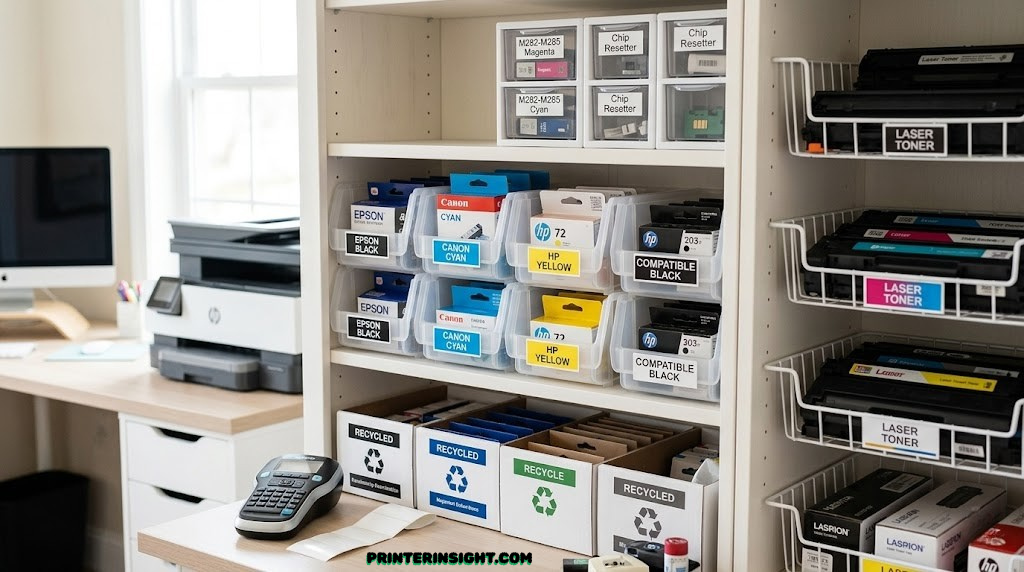
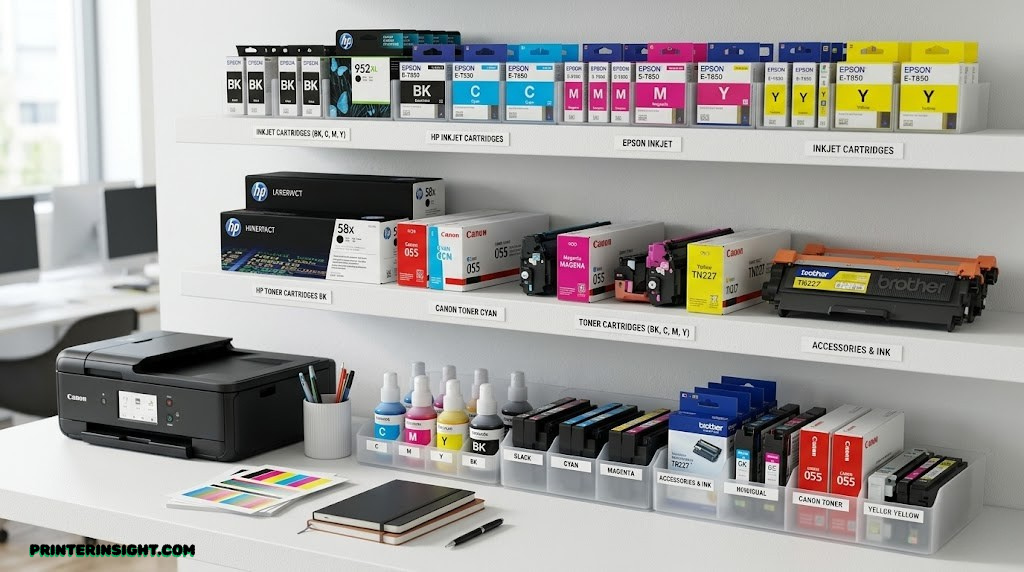
Building an Effective Cartridge Organization System
Haphazard cartridge storage leads to lost supplies, expired cartridges, and frustration. A simple organization system prevents chaos:
The Basic Storage Checklist
- Designate a single storage location (bedroom closet, cabinet, drawer)
- Separate by printer model if you have multiple printers
- Group by color (all cyan together, magenta together, etc.)
- Label containers with date and cartridge colors
- Store sealed cartridges away from opened ones
- Keep newest cartridges at back, oldest at front (FIFO)
- Maintain inventory list (spreadsheet or notebook)
- Check storage location temperature/humidity quarterly
- Rotate stock: use oldest cartridges first
- Replace desiccant packets annually for long-term storage
Storage Container Options
- Ziplock bags: Free, reusable, adequate for 6-month storage. Include desiccant packet.
- Plastic storage boxes: $5–15, stackable, good for organization. Choose airtight models.
- Desk organizers: $10–30, visible, good for current-use stock. Less effective for long-term.
- Filing cabinet: $50–150, professional appearance, excellent climate control if indoors.
- Climate-controlled safe: $100–400, premium option for valuable cartridge stockpiles.
Common Mistakes That Damage Stored Cartridges
❌ Removing Protective Seals Too Early
Never remove cartridges from factory sealed packages until installation day. Removing seals exposes nozzles to air immediately. Nozzles begin drying within hours of seal removal. If you remove a seal and don’t install immediately, that cartridge has been permanently damaged.
❌ Storing Near Heat Sources
Never store cartridges near heaters, radiators, sunny windows, or electronics that generate heat. Heat above 85°F causes ink to thin and evaporate. Even temporary heat exposure (a few hours in sunlight) degrades ink quality. Maintain consistent cool conditions.
❌ Storing in High-Humidity Areas
Bathrooms, kitchens, and damp basements are cartridge death zones. Humidity above 70% causes mold growth and metal contact corrosion. Even temporary high humidity exposure (a humid summer in a non-air-conditioned space) causes degradation. Keep away from moisture at all costs.
❌ Leaving Cartridges Unpackaged in Open Air
Open storage—cartridges sitting on desks or shelves—exposes them to dust, light, temperature fluctuations, and humidity. Never store cartridges outside sealed containers for extended periods. Even a week of open storage accelerates nozzle drying.
❌ Storing Horizontally or Nozzle-Down
Gravity causes ink to settle away from nozzles when cartridges are stored horizontally or upside-down. Upon installation, the printer must work harder to prime nozzles, potentially damaging them. Always store upright with nozzles pointing upward.
❌ Forgetting Storage Location
Lost cartridges can’t be used. Jot down the storage location in a notebook or phone. Better yet: maintain a simple inventory spreadsheet tracking cartridge quantity, colors, storage location, and purchase date. Review quarterly.
❌ Mixing Printer Brands
Mixing HP, Canon, and Epson cartridges in the same container creates confusion. Label containers clearly by printer brand and model. Mistakes result in lost time or installing incompatible cartridges.
Troubleshooting: What to Do If Stored Cartridges Go Bad
Cartridge Leaked During Storage
If leaking occurs, the cartridge seal has failed. The cartridge is unusable and should be replaced. Wipe leaked ink with paper towels (wear gloves—ink stains permanently). Inspect the storage container for damage and clean before reusing. Leaking typically indicates environmental damage (excessive heat or pressure) or a defective cartridge from manufacturing.
Dried Ink Visible on Cartridge Exterior
Some ink residue on the outside is cosmetic and doesn’t affect function. However, if dried ink coats the nozzle plate, the cartridge may fail to print. Try gentle cleaning with a damp cotton swab before replacement. If cleaning fails, replace the cartridge.
Cartridge Won’t Prime After Long Storage
Cartridges that sit unused for 6+ months sometimes resist priming when first installed. Run the automatic print head cleaning cycle immediately after installation. This forces ink through resistant nozzles and usually restores function within 1–2 cycles. If cleaning doesn’t work, try manual cleaning or replacement.
Color Output Faded or Wrong Color Printed
Extended storage can cause pigment settling or partial degradation. Test on low-value print jobs first. If color continues degrading or doesn’t match expectations, replace with fresh cartridges rather than troubleshooting—fresh supplies cost less than your time.
Cartridge Physically Cracked or Damaged
Physical damage (cracked plastic, dents, obvious manufacturing defects) means the cartridge was compromised before storage. Don’t attempt to use—damaged cartridges risk printer damage from leaking or internal debris. Replace immediately.
Cartridge Storage Frequently Asked Questions
Sealed cartridges in original packaging stored in ideal conditions last 2–3 years. Beyond three years, degradation accelerates. Opened or partially used cartridges last 6–12 months. Always use oldest cartridges first (FIFO method) to prevent age-related expiration.
Not recommended. Refrigerators maintain constant cool temperature (good) but high humidity from condensation (bad). Freezers can work but require proper sealing to prevent moisture condensation during thawing. The effort isn’t worth the marginal benefit—room temperature storage is simpler and nearly as effective.
Ideal humidity is 40–60% relative humidity. Cartridges tolerate brief excursions to 30–70% but suffer when exposed regularly to humidity above 70% (mold, corrosion) or below 30% (rapid evaporation). Most climate-controlled homes naturally maintain acceptable humidity—if you’re comfortable, cartridges likely are too.
Sealed cartridges in original packaging can be stored any position since the seal prevents ink movement. Once opened, store upright with nozzle pointing up. This prevents ink from settling away from nozzles, which complicates priming when installed. Horizontal or inverted storage of opened cartridges can cause print quality issues.
Yes, storing different brands in the same container is safe. However, clearly label containers by brand and printer model to prevent installation mistakes. Mixing HP and Canon cartridges in the same container without labeling invites errors—you might install incompatible cartridges.
For short-term storage (under 6 months), desiccant packets are optional. For long-term storage (6 months–2 years), they’re highly recommended. Desiccant packets are inexpensive ($1–3) and dramatically extend cartridge lifespan by absorbing ambient moisture. Include them in airtight containers for extended storage.
Separate by printer model first (if you have multiple printers), then organize by color (cyan, magenta, yellow, black). Label containers with storage date and contents. Implement FIFO (First In, First Out): use oldest cartridges first, add new ones to the back. Maintain a simple inventory spreadsheet or notebook tracking quantities and locations.
Signs of degradation: visible leaking, dried crusty ink on nozzles, cracked plastic, or ink that has separated into layers (seen through transparent housing). If you suspect a cartridge is compromised, test it on a non-critical print job first. If print quality is poor, replace rather than troubleshoot.
Yes—cooler (but not cold) storage does extend lifespan. However, extremely cold conditions (below 50°F) can damage cartridges through ink thickening and seal brittleness. Optimal is 65–75°F. A cool bedroom closet is ideal; don’t artificially chill cartridges below 65°F.
Yes—opened cartridges degrade much faster. Store opened cartridges upright in sealed plastic bags (ziplock) with desiccant packets. Keep separate from sealed inventory. Use opened cartridges within 6–12 months. Sealed cartridges can last 2–3 years but opened ones typically last 6–12 months maximum.
Conclusion: Preserve Your Cartridge Investment
Printer cartridges are investments—$15–60 per unit adds up quickly across backup supplies. Proper storage preserves that investment, ensuring cartridges remain usable for 2–3 years. Improper storage transforms your investment into worthless waste within weeks.
The essential storage principles are simple: maintain stable, cool, dark, low-humidity conditions. Keep cartridges sealed in original packaging when possible. For long-term storage, add airtight containers and desiccant packets. Label everything with storage dates and implement FIFO rotation to prevent expiration through age.
The payoff is substantial. A home office or small business maintaining proper cartridge storage pays dividends: cartridges always print when needed, no lost supplies to degradation, and no emergency cartridge purchases at inflated prices. The small investment in organization infrastructure—labels, containers, desiccant packets—costs under $20 and protects hundreds of dollars in supplies.
Start today: designate a storage location, organize existing cartridge supplies, label containers with dates, and commit to using oldest supplies first. Your future self will thank you when every cartridge prints flawlessly instead of being ruined by improper storage.
📦 Organize Your Cartridge Supplies Today
Implement the storage strategies outlined in this guide and ensure your printer cartridge investments remain viable for 2–3 years. A few minutes of organization now prevents frustration and waste later.